
News & Commentary
Dec 15, 2017
When police kill someone, they need to release all the facts—not just the ones they like.
On Thursday night, New Britain police shot and killed one person and shot and injured two other people. All three people were in a car.
By David McGuire

Dec 12, 2017
Mass surveillance? Hartford could have it.
The Hartford City Council approved a grant to allow city police to expand surveillance camera and drone programs. Separately, these programs threaten civil liberties. Together, they could be a nightmare for anyone who cares about safety, justice, equality, and freedom in the capital city.
By David McGuire

Sep 05, 2017
Now Accepting Nominations for the ACLU of Connecticut Board of Directors
Any member of the ACLU of Connecticut may recommend any member (including self) for one of the approximately 20 at-large seats on the board of directors. To do so, the member must send the name and contact information of both the person making the recommendation and the person being recommended (if different) on or before September 25, 2017, to info@acluct.org, or write to us at ACLU of Connecticut, 765 Asylum Avenue, Hartford CT 06105.
Aug 29, 2017
I’m a Police Officer Serving My Community. My Pregnancy Made Me Unwelcome On the Force.
As a woman working in law enforcement, I’ve become accustomed to being in the minority — it’s something women know when choosing a career in policing. But after six years on the job, what I didn’t anticipate was the discrimination I would face for being pregnant.
By Sarah Alicea

Aug 16, 2017
Statement from the ACLU of Connecticut on Justice, Equality, and Charlottesville
Statement from David McGuire, Executive Director of the ACLU of Connecticut:
Aug 03, 2017
Connecticut Takes Nine More Steps Toward Criminal Justice Reform
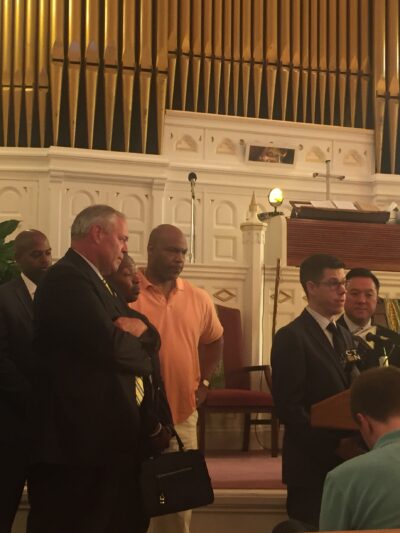
HARTFORD – The ACLU of Connecticut joined Governor Dannel Malloy and other dignitaries at Faith Congregational Church on August 2 for the ceremonial signing of nine justice reform bills, including four supported by the ACLU-CT. These ACLU-CT-supported bills included:
Jun 15, 2017
Commission Tells Enfield to Turn Over Police Lawsuit Documents to the ACLU-CT
When an Enfield police officer was named in 11 excessive force lawsuits, the town tried to keep the lawsuit settlements secret. We took action and won.In 2014, police dashboard camera video footage surfaced of an Enfield police officer beating a man in the head as the man lay handcuffed on the ground. By the time that officer, Matthew Worden, was fired and decertified, he had been the subject of 14 internal affairs investigations by the police department and had been named in 11 excessive force lawsuits alleging that violated people’s rights.By June 2017, the town of Enfield had settled eight of those 11 lawsuits, but it refused to share the details of these settlements, including how much they cost, with the public.When towns shroud lawsuit settlements in secrecy, it doesn’t help to build community trust in open, transparent government. The public deserves to know how much Enfield paid to settle these lawsuits involving a town employee.The ACLU of Connecticut took action by demanding documents from Enfield regarding the settlements for three of the lawsuits: Salas v. Town of Enfield, Avalos v. Town of Enfield, and Trowbridge v. Town of Enfield. When the town refused to turn over that information, the ACLU of Connecticut appealed to the state Freedom of Information (FOI) Commission.In a preliminary decision, FOI Commission hearing officer Lisa Fein Siegel recommended that the full Commission order Enfield to provide the ACLU of Connecticut with all of the information we sought. On June 14, 2017, the full FOI Commission met and issued its final ruling, which fully adopted the hearing officer’s recommendations. Enfield did not have a representative at that hearing; once Enfield receives the FOI Commission’s final ruling in the mail, the town will have 45 days to either appeal the Commission’s decision or, as ordered, turn over documents to the ACLU of Connecticut.Democracy works best in the light. Transparency is critical for people to know what their town governments are doing in their names, and whether those actions meet their expectations.For more background about the lawsuits against Enfield police officer Worden [this link will take you to the Hartford Courant's website]: http://www.courant.com/community/enfield/hc-enfield-foi-hearing-matthew-worden-lawsuit-settlements-0614-20170613-story.html
Jun 08, 2017
Nine Ways Connecticut Could Become More Equal, Just, and Free in 2017
The ACLU of Connecticut spoke out for justice, equality, and liberty during the 2017 legislative session--and so did our supporters. By the end of the General Assembly's 2017 regular session, ten bills to advance justice, equality, and liberty had passed out of the legislature.
Stay Informed
Sign up to be the first to hear about how to take action.
By completing this form, I agree to receive occasional emails per the terms of the ACLU’s privacy statement.
By completing this form, I agree to receive occasional emails per the terms of the ACLU’s privacy statement.