
News & Commentary
Mar 09, 2017
Stopping Civil Asset Forfeiture
Civil asset forfeiture allows the government to take and sell someone’s property without ever charging them with a crime. Taking innocent people’s assets is unacceptable and unconstitutional, but it is happening in Connecticut. From 2009 to 2013, there were more than 3,700 civil asset forfeiture cases in our state. In 2017, we successfully advocated for legislation to fix civil asset forfeiture in our state. Under a proposal signed into law by Governor Malloy, the state will only be allowed to confiscate property that was related to a criminal conviction.
Jan 26, 2017
Earning Trust: Addressing Police Misconduct Complaints in Connecticut
Police agencies in Connecticut routinely make it difficult for members of the public to file complaints of police misconduct, according to this 2017 report by the ACLU of Connecticut, a follow-up to our 2012 report on the same topic.Drawn from online research and telephone surveys, “Earning Trust: Addressing Police Misconduct Complaints in Connecticut,” shows that many police agencies in the state fail to clearly post their complaint policies and forms online, refuse to accept anonymous complaints, and include threats of prosecution in their complaint intake protocols. In some cases, these obstacles violate state law and statewide police policy. Together, these barriers to transparency can undermine public trust in law enforcement.
Jan 06, 2017
Five Things on Our 2017 Legislative To-Do List
On Wednesday, January 4, state legislators returned to Hartford to begin a new legislative session of the Connecticut General Assembly. Here are five areas in which the ACLU of Connecticut will be encouraging the legislature to strengthen freedom, equality, and justice in 2017:

Oct 03, 2016
Remembering Bill Olds
The American Civil Liberties Union of Connecticut is saddened to learn of the passing of William “Bill” Olds, a staunch defender of civil liberties and the organization’s first full-time executive director, who died on Friday, September 30. Bill took the helm of the ACLU-CT, then known as the Connecticut Civil Liberties Union, in 1970, and his steady hand guided the group for twenty-five years, until his retirement in 1995.The Hartford Courant once dubbed Bill, a Bloomfield resident, “Mr. Civil Liberties,” and he more than earned the title. Bill was a friend to the marginalized, an ally to the vulnerable, and a champion of civil liberties for all. Under his direction, the ACLU-CT overturned Connecticut’s ban on the use of state funds to provide abortion care for low-income women, cleared the way for the first woman firefighter in New Haven, secured religious observance rights for inmates at the Danbury Federal Correctional Institution, fought against forced sterilization of children with mental disabilities, and sought equality in education. With clarity and conviction, he eloquently defended the rights to peaceful assembly and free speech, including for groups with which he strongly disagreed. In Bill, freedom found a champion of consistent principles and unwavering certitude. His devotion to equality and justice were evident to all who knew him, and he gracefully shouldered his mantle as a constant civil liberties ambassador.The entire ACLU-CT family is grateful beyond measure to Bill and his entire family for his years of shepherding civil liberties in the Constitution State. We extend our heartfelt sympathies to his wife, Astrida, and their daughters.
Jun 30, 2016
Police Tasers in Connecticut
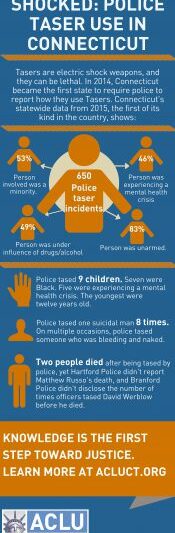
Tasers are powerful electric shock weapons, and they can be lethal. For years, the American Civil Liberties Union of Connecticut (ACLU-CT) has called for Connecticut to ensure that police only use Tasers fairly, justly, and wisely. In 2014, the ACLU-CT helped to pass the first law in the nation requiring police to provide information about how and when they use Tasers. As a result of that law, in 2016, Connecticut released the first statewide report in the country regarding police Taser use. That report shows troubling racial disparities in how police used Tasers, and that an inordinate number of police Taser incidents involved people who were experiencing mental health crises or under the influence of drugs or alcohol. According to ACLU-CT research, at least 18 people have died after being tased by police in Connecticut. Of those 18 people, at least 12 were Black or Latino.
May 15, 2016
7 Ways Connecticut Could Become More Equal, Just & Free in 2016
The ACLU of Connecticut spoke out in support of liberty, justice, and equality during the 2016 legislative session. In the end, the legislature passed--and Governor Malloy signed--seven new bills into law. These new laws to advance civil liberties would: spearhead a study to improve police training; prevent the state from detaining juveniles for more than seven days without a hearing and require closure of two juvenile detention facilities; require the Department of Correction to create a plan to reduce negative mental health effects on youth in correctional facilities; create fair chances at employment for people with criminal records; add protections for religion, national origin, sex, sexual orientation, and gender identity or expression for people who serve in Connecticut's military departments, such as the National Guard; protect student privacy by preventing people from tracking students' data and limiting how school-contracted groups can collect or share students' information; and increase cellphone privacy protections.
Apr 13, 2016
ACLU-CT Advocates Speak Out for Fair Chance Employment
By giving people who have made mistakes a fairer chance to earn a job, the Connecticut Fair Chance Employment Act takes steps to make our state more just and equal. As the ACLU of Connecticut has testified, it has the potential to change lives. Advocates like Rafael, Nelson, Anderson, and Jonathan are speaking out to share their stories. They are people of faith, fathers, grandfathers, neighbors, business owners, and friends. We sat down to ask them for their "six word memoirs" about what "justice" and Fair Chance Employment mean to them. Here is what they had to say:


Stay Informed
Sign up to be the first to hear about how to take action.
By completing this form, I agree to receive occasional emails per the terms of the ACLU’s privacy statement.
By completing this form, I agree to receive occasional emails per the terms of the ACLU’s privacy statement.